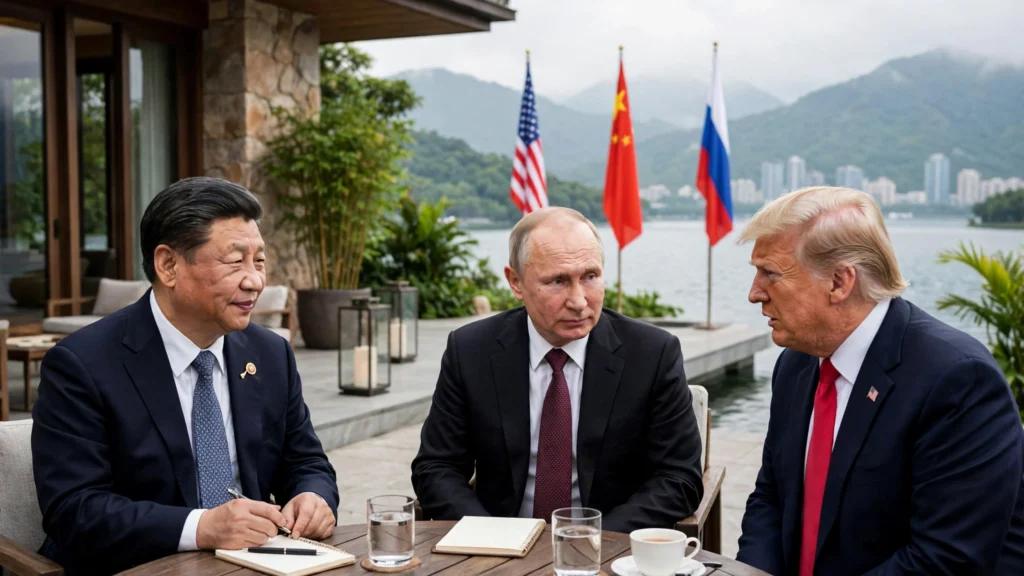
The Trump Xi Putin trilateral summit Shenzhen is happening today. The leaders of the United States, China and Russia — Donald Trump, Xi Jinping and Vladimir Putin — are sitting down together today in Shenzhen, in the first-ever trilateral meeting of the three countries, on the sidelines of the APEC summit, with an agenda running from nuclear weapons to Ukraine, from Iran to trade, and from there to artificial intelligence. The stakes could hardly be higher; the expectations, officials say, are a good deal lower.
The United States and Russia have no nuclear treaty left between them. The United States and China have spent the year arguing over trade. Russia and China have grown closer while the war in Ukraine continues. What follows is what is actually known about today: where it is happening, in what order, what is on the agenda, and why officials are playing down the chance of a deal.
Trump Xi Putin trilateral summit Shenzhen A first, on the sidelines of APEC
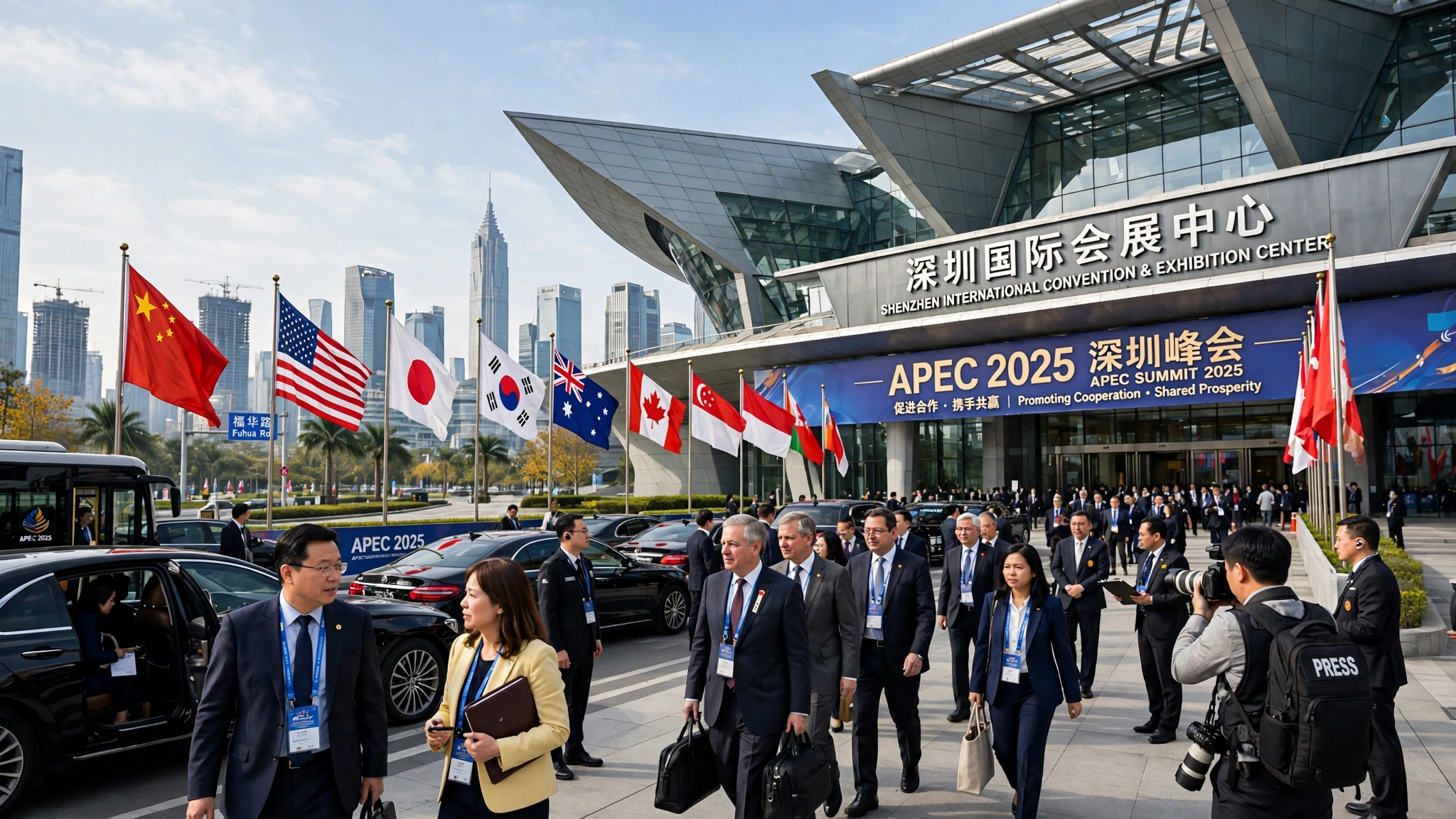
The meeting takes place on Thursday, 19 November 2026, on the sidelines of the APEC summit in Shenzhen — a gathering of Pacific economies, in a southern Chinese city built on trade and technology. The trilateral itself is not an APEC session, but a meeting arranged around its edges, using the fact that all three leaders are in the same place at the same time.
Leaders of the three countries have met in pairs many times over many decades, but never as a trio. Today changes that, creating a precedent — a format that, once used, can be used again — and letting each leader speak to the other two at once.
The setting: Kylin Villa, beside Xili Lake
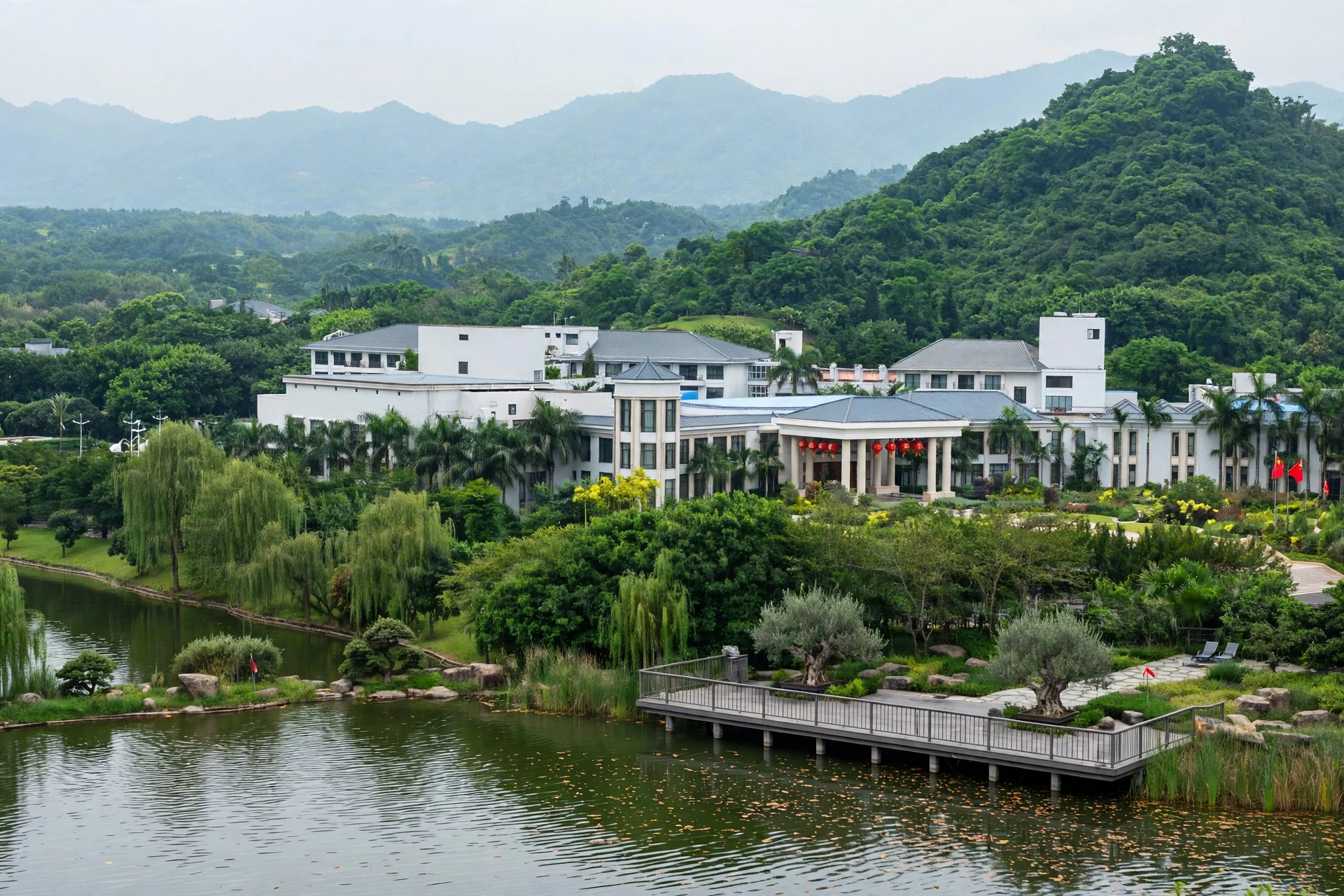
The venue is Kylin Villa, a 38-hectare lakeside property in the foothills of Kylin Mountain, next to Xili Lake, about 30 minutes from Shenzhen Bao’an airport. This is not a conference centre with rows of flags. It is a secluded property by a lake, at the foot of a mountain — a place chosen for privacy, for atmosphere, and for the images it will produce.
The property’s size means the meeting can be held away from the main APEC crowds, with space for the separate conversations planned around the trilateral itself — seclusion that, for a meeting this sensitive, is part of how the day is meant to work.
How the day is structured
Trump holds a bilateral meeting and working lunch with Xi first, then the trilateral follows. A separate Trump-Putin one-on-one is also planned.
Start with the Trump-Xi bilateral and working lunch — less formal than a summit session, more substantial than a handshake — giving the two leaders time to talk through US-China issues before the third leader joins them. Trade is the most obvious of those issues, and it was already in the air the day before, when Xi called for an end to trade “protectionism”.
Then comes the trilateral itself, with all three leaders in the room, and alongside it a separate Trump-Putin one-on-one — a reminder that the US-Russia relationship has its own agenda, and that Ukraine and nuclear arms control are matters the two of them need to discuss directly.
What is on the agenda
The agenda covers five broad subjects: nuclear arms control and reductions, the Russia-Ukraine war, Iran, trade, and AI — each enough to fill a summit on its own.
Nuclear arms control comes first, for a concrete reason. The last US-Russia nuclear treaty, New START, expired in February 2026, after being in force from 5 February 2011 to 4 February 2026 — leaving the two countries without the framework that for fifteen years limited their deployed strategic nuclear weapons and provided for verification.
China has resisted joining trilateral disarmament talks, so any discussion of reductions without Beijing is incomplete in a world where China is now a major nuclear power — and any discussion with Beijing must overcome its reluctance to take part. Xi being in the room does not resolve that, but the question can now be put to him directly.
The Russia-Ukraine war carries its own sensitivities. Volodymyr Zelenskyy has expressed concern that the meeting could discuss a Ukraine deal behind Kyiv’s back — an understandable worry when the war is discussed by Washington, Beijing and Moscow without Kyiv in the room. Iran, trade and AI complete the agenda. Trade is the issue Xi raised the day before, and the one that most directly affects businesses and consumers far beyond Shenzhen — readers following the market impact can check the Sensex and Nifty market coverage. AI is the newest item on a leaders’ agenda of this kind: a technology all three countries are racing to develop, and that none of them has yet agreed how to govern.
The day before: arrivals, greetings and warnings
The meeting did not begin today. Its tone was set on 18 November by arrivals and remarks that each carried a message. Xi greeted Trump at the airport — a rare gesture, reciprocating Trump’s reception of Xi in Washington in September. A leader who comes to the airport in person is making a statement about the relationship.
Putin arrived earlier on 18 November, so by the time Trump landed, two of the three leaders were already in Shenzhen. Xi called for an end to trade “protectionism”, aimed at the tariffs and restrictions that have defined the US-China economic argument. Putin criticised Western sanctions, imposed on Russia above all since the war in Ukraine began. Neither remark was a surprise; both signalled what each leader would bring into the room, and the positions they would not easily give up.
Why officials expect symbolism over substance
For all the weight of the agenda, the people closest to the preparations are urging caution about what today will produce. US officials have said: “We do not expect to get to any kind of agreement.” Analysts, similarly, expect symbolism over substance.
That is striking on the morning of a first-ever trilateral summit. It does not mean the meeting is pointless: symbolism is itself a form of substance, and the fact of the meeting sends signals to allies, adversaries and home publics alike. But anyone expecting a signed agreement is likely to be disappointed — the gaps are wide, the time is short, and these issues take months of negotiation, not a single afternoon.
The Xi-Putin relationship is part of the backdrop: the two have met in person seven times, most recently in Alaska in August 2025. They arrive with a shared understanding Trump does not share with either of them, so this is not a meeting of three equals starting from scratch.
What today will — and will not — settle
So what should a reader take from today? The meeting’s importance lies less in what it decides than in what it reveals: China is willing to host a trilateral of this kind and put its leader in the same room as the American and Russian presidents; the United States is willing to take part even while saying no agreement is expected; and Russia, under sanctions and at war, is still treated as a party to conversations about nuclear weapons, Ukraine and the wider order — a fact that will be read very differently in Kyiv, in European capitals, and in Washington.
What today will not settle is any of the five items on the agenda. No new nuclear treaty will be signed in an afternoon, the war in Ukraine will continue tomorrow, trade “protectionism” will not end because the word was used at a summit, and AI will still await agreed rules when the leaders leave. The photograph will be historic. The substance, if the officials are right, will come later — if it comes at all.
Read more
For the full reporting behind this story, see The Hindu: Trump-Xi-Putin Shenzhen meeting 2026 — agenda and significance and The Indian Express: APEC summit Shenzhen — Xi, Putin and Trump trilateral meeting, trade and sanctions.
When and where is the Trump-Xi-Putin trilateral summit?
On Thursday, 19 November 2026, on the sidelines of the APEC summit in Shenzhen, at Kylin Villa — a 38-hectare lakeside property in the foothills of Kylin Mountain, next to Xili Lake, about 30 minutes from Shenzhen Bao’an airport. It is the first-ever trilateral meeting of the US, China and Russia leaders.
What is on the agenda for the Shenzhen meeting?
Nuclear arms control and reductions, the Russia-Ukraine war, Iran, trade and AI. Trump holds a bilateral meeting and working lunch with Xi first, then the trilateral, with a separate Trump-Putin one-on-one also planned.
Why is nuclear arms control on the agenda now?
The last US-Russia nuclear treaty, New START, expired in February 2026, after being in force from 5 February 2011 to 4 February 2026. China has resisted joining trilateral disarmament talks.
Is an agreement expected from the summit?
No. US officials said: “We do not expect to get to any kind of agreement.” Analysts expect symbolism over substance. Zelenskyy has expressed concern the meeting could discuss a Ukraine deal behind Kyiv’s back.

Ayush Choudhary is the Founder & Editor-in-Chief of The Brave India, where he covers India news, state news, local news and government updates. He leads the newsroom’s reporting on markets, technology, sports and public policy, with a focus on accurate, timely stories for readers across the country.