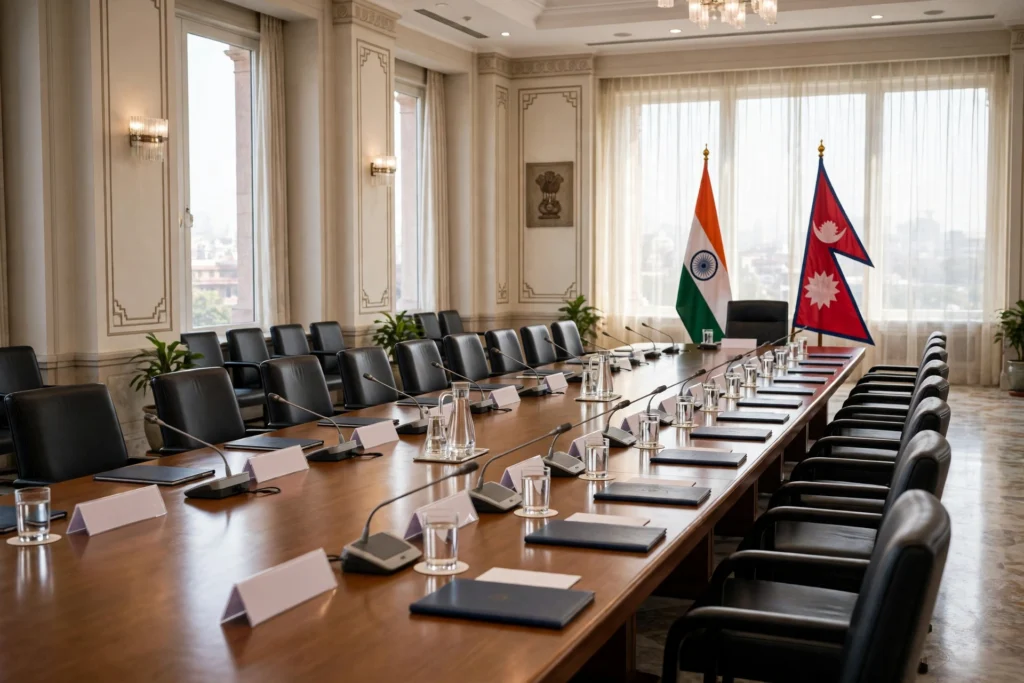
There is a particular weight to a first visit. When a new prime minister chooses where to travel first, neighbours read the itinerary as a statement of intent — and that is exactly how Kathmandu and New Delhi are reading this week. The Nepal PM Balendra Shah India visit reaches its centrepiece today, Monday 23 November 2026, with delegation-level talks between Prime Minister Balendra Shah and Prime Minister Narendra Modi in New Delhi.
This report sets out what is scheduled, who has travelled with the Nepalese prime minister, what both sides want from the table, and what the two prime ministers actually agreed when they met.
The talks have now concluded. Prime Minister Narendra Modi and Prime Minister Balendra Shah adopted a Joint Vision for a ‘Viksit Bharat and Samunnat Nepal’, exchanged eight memorandums of understanding, and announced development assistance of Rs 15,000 crore (24,000 crore Nepali rupees) for post-flood reconstruction, new infrastructure and energy projects. The two leaders also flagged off the Sarayu-Kamala Express between Ayodhya and Janakpur and jointly inaugurated or laid foundation stones for major connectivity and energy projects.
Shah arrived in New Delhi on Sunday 22 November for a two-day State visit running from 22 to 23 November, at Prime Minister Modi’s invitation. It is his first bilateral visit abroad since taking office in March 2026, and his first visit to India as prime minister.
On arrival, he was welcomed by Minister of State Jitin Prasada. For a leader still in his first year in office, the choice of New Delhi for that first bilateral outing underlines how central India Nepal relations remain to Kathmandu’s foreign policy — and how much unfinished business the two governments have to work through.
Nepal PM Balendra Shah India visit: today’s schedule
The formal programme for today, Monday 23 November, is anchored by the delegation-level talks with Prime Minister Modi, according to the Ministry of External Affairs schedule reported this morning. The delegation-level talks were held at Hyderabad House, followed by a joint press statement and an official luncheon hosted by Prime Minister Modi.
Beyond the main talks, Shah is scheduled to call on President Droupadi Murmu, and External Affairs Minister S. Jaishankar will pay a courtesy call on him. That sequence gives both sides several settings in one day to settle disagreements and agree the wording of whatever joint outcomes they plan to announce.
You can follow the day’s official framing in the IANS report on today’s delegation-level talks, published this morning.

Who is in the Nepalese delegation?
Shah is not travelling light. He is accompanied by a 35-member government delegation that includes Finance Minister Swarnim Wagle, Foreign Minister Shishir Khanal and Chief Adviser Kumar Byanjankar. A separate 52-member business delegation has also travelled for the visit.
That split matters. The government delegation signals talks ranging across finance, foreign policy and the prime minister’s office — not a single-issue meeting. The separate business delegation points to a commercial track alongside the official one, including a Nepal-India Business Forum expected as part of the programme.
Our preview of the visit, published when the programme was announced, set out the background in Nepal PM Balendra Shah’s India visit on 22–23 November.
What is on the agenda?
The stated agenda is deliberately broad: the full range of India–Nepal relations. Within that, the areas named in reporting ahead of the talks are trade, transport, investment, energy, connectivity and infrastructure. Two practical files stand out from the list.
The first is post-flood reconstruction following the floods of 26 August. Recovery work of that kind tends to pull in questions of funding, project timelines and cross-border coordination, and it gives today’s talks a concrete, time-sensitive item alongside the longer-term partnership language. The second is connectivity in its several forms — roads and transport links, energy cooperation, and the digital and infrastructure projects that both governments have been discussing.
Each side also arrives with its own asks. Nepal is seeking additional air entry routes, along with trade and transit concessions. India, for its part, is seeking access to Nepali airspace and a better investment climate in Nepal, especially in the energy sector.
None of these is a small technicality: air routes shape tourism and trade, transit terms shape the cost of everything a landlocked economy imports and exports, and energy investment conditions shape whether projects move from paper to construction.
What was agreed at the talks?
The centrepiece outcome is the Joint Vision for a ‘Viksit Bharat and Samunnat Nepal’, adopted by the two prime ministers as the roadmap for a future-oriented partnership. Pre-talks reporting had described the framework by its theme, Samriddha Nepal Samunnat Bharat (Prosperous Nepal, Developed India); the adopted Joint Vision covers economic and development partnership, connectivity, energy and water resources and people-to-people linkages, along with new areas including climate resilience, disaster mitigation and management, sports, start-ups, digital services, space and innovation.
India announced development assistance of Rs 15,000 crore (24,000 crore Nepali rupees), comprising Rs 3,500 crore in grant assistance for post-disaster reconstruction and new infrastructure projects, and a rupee-denominated Line of Credit of Rs 11,500 crore for energy sector projects. The package follows the devastating Rasuwa-Bhotekoshi floods in August, for which Prime Minister Shah thanked India for its humanitarian and technical support.
Eight MoUs were exchanged: academic and research collaboration between the National Forensic Sciences University, Gandhinagar and the Crime Investigation Department of Nepal Police; cooperation between Rashtriya Raksha University and Nepal’s National Police Academy; civil-service capacity building between India’s National Centre for Good Governance and the Nepal Administrative Staff College; cooperation in Ayurveda and other traditional systems of medicine; an ISRO–Nepal satellite communication (SATCOM) network for use of the South Asia Satellite; technical cooperation in sustainable urban development; cooperation in health and medicine between the two health ministries; and cooperation in livestock and fisheries development.
On connectivity and energy, the two prime ministers flagged off the inaugural Sarayu-Kamala Express rail service between Ayodhya and Janakpur, inaugurated the Dharchula–Darchula motorable bridge, and dedicated Phase II of the Motihari–Amlekhgunj petroleum pipeline. They laid foundation stones virtually for an Integrated Check Post at Banbasa, a petroleum terminal at Jhapa and the 669 MW Lower Arun Hydro-Electric Project. India also announced a new transit-trade avenue for Nepal through Deendayal Port (Kandla), with access to Paradip port to follow once infrastructure is in place, and the two sides agreed that the Kathmandu–Bhairahawa–Lucknow air route will be made bidirectional, with technical consultations on other civil aviation proposals. The leaders also agreed that India will set up an off-shore IIT campus in Nepal.
Why this visit matters beyond the day
First visits set the tone for a relationship, and both capitals have reasons to want this one to produce more than photographs. For Kathmandu, a new government needs visible progress on trade, transit and reconstruction — the files that touch daily life. For New Delhi, Nepal sits at the heart of its neighbourhood policy, and energy and connectivity cooperation with Kathmandu carries weight well beyond the bilateral file.
The breadth of the adopted framework is itself a signal: not a narrow trade deal, but an attempt to give the whole relationship a shared vocabulary and, if the reported measurable targets survive into the final text, a way to judge progress later.
The visit also lands in a busy diplomatic season for New Delhi. Readers following the wider economic-diplomacy picture can see how the government has been framing jobs, salaries and tax questions at home in PM Modi at FICCI: salary hike, jobs and tax cuts.
What happens next?
The joint press conference has now concluded and the official outcomes above are confirmed in the joint press release issued in New Delhi on 23 November 2026. Attention will now shift to implementation: finalising the specific projects and modalities under the Rs 15,000 crore package through mutual consultations, completing the technical talks on civil aviation, and carrying forward railway, hydropower and transmission projects named in the joint statement, including the Raxaul–Kathmandu railway survey and the Pancheshwar project report.
Conclusion
The Nepal PM Balendra Shah India visit held delegation-level Balendra Shah Modi talks, addressed a joint press statement and attended an official luncheon hosted by Prime Minister Modi, a call on President Droupadi Murmu and a courtesy call by External Affairs Minister S. Jaishankar.
A 35-member government delegation and a separate 52-member business delegation underline the breadth of the agenda — trade, transport, investment, energy, connectivity, infrastructure and post-flood reconstruction. The Joint Vision for a ‘Viksit Bharat and Samunnat Nepal’, eight exchanged MoUs, a Rs 15,000 crore development package and a set of connectivity and energy launches now give the first visit a concrete record. Whether it is remembered as the day India Nepal relations acquired a new working blueprint will depend on how quickly these commitments move from announcement to construction.
Read more
Nepal PM Balendra Shah India Visit
Balendra Shah Modi Talks
India Nepal Relations
Samriddha Nepal Samunnat Bharat
Nepal PM New Delhi Visit
Why is Nepal PM Balendra Shah visiting India?
Prime Minister Balendra Shah is on a two-day State visit to India from 22 to 23 November 2026 at Prime Minister Narendra Modi’s invitation. It is his first bilateral visit abroad since taking office in March 2026 and his first visit to India as prime minister, centred on delegation-level talks with PM Modi in New Delhi today.
What is on the agenda of the Balendra Shah–Modi talks?
The agenda covers the full range of India–Nepal relations, including trade, transport, investment, energy, connectivity and infrastructure, plus post-flood reconstruction after the 26 August floods. Nepal seeks additional air entry routes and trade and transit concessions, while India seeks Nepali airspace access and a better investment climate, especially in energy.
What is the Samriddha Nepal, Samunnat Bharat document?
Samriddha Nepal, Samunnat Bharat (Prosperous Nepal, Developed India) was the theme used in reporting ahead of the visit for the planned joint vision framework. On 23 November 2026 the two prime ministers adopted the Joint Vision for a ‘Viksit Bharat and Samunnat Nepal’ as the roadmap for a future-oriented partnership, covering economic and development partnership, connectivity, energy and water resources, people-to-people linkages, climate resilience, disaster management, sports, start-ups, digital services, space and innovation.
Who is travelling with the Nepalese prime minister?
Shah is accompanied by a 35-member government delegation including Finance Minister Swarnim Wagle, Foreign Minister Shishir Khanal and Chief Adviser Kumar Byanjankar, plus a separate 52-member business delegation. His programme includes a call on President Droupadi Murmu and a courtesy call by External Affairs Minister S. Jaishankar.

Ayush Choudhary is the Founder & Editor-in-Chief of The Brave India, where he covers India news, state news, local news and government updates. He leads the newsroom’s reporting on markets, technology, sports and public policy, with a focus on accurate, timely stories for readers across the country.