For a few minutes on Sunday evening, cities and towns across Uttar Pradesh practised something most residents have only seen in films: what to do when the sirens sound and the lights go out. The UP blackout mock drill, conducted on 22 November 2026 across all 75 districts of the state, was a preparedness exercise — planned, announced in advance, and designed to test how quickly civil defence teams, police, hospitals and district administrations can move together if a real emergency ever demands it.
This report explains what happened, who took part, what residents in different districts saw, and why the state ran the exercise at all.
The drill began at 6 PM on Sunday. It was organised by the Civil Defence Department under directives from the Central and Uttar Pradesh governments, following Home Ministry guidelines. That chain of authority matters for understanding the exercise: this was not a local initiative in a handful of towns, but a coordinated, state-wide rehearsal run to a common template, at the same hour, in every district.
UP blackout mock drill: what actually happened at 6 PM?
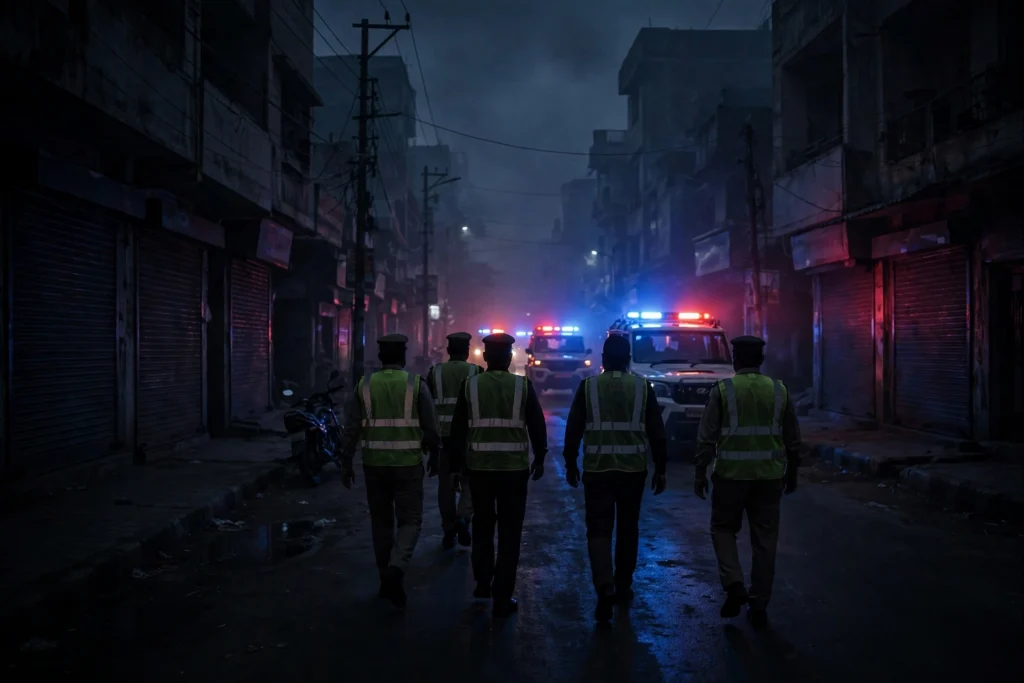
The sequence was deliberately simple, because simple sequences are the ones people remember under pressure. First, a two-minute air-raid siren sounded. Then, in selected areas, a blackout of roughly ten minutes followed — lights switched off so that the locality practised operating in darkness.
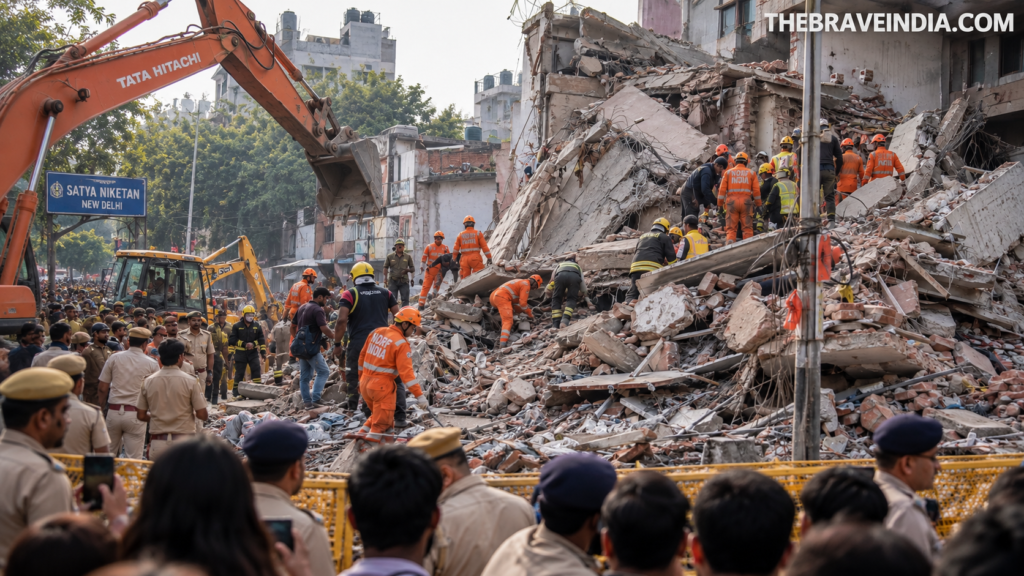
Around that core sequence, districts staged rescue demonstrations: firefighting, first aid, evacuation of people from debris, and shifting the injured to hospitals. Each of those elements tests a different link in the chain. Firefighting tests equipment and water supply. Debris evacuation tests manpower and coordination. Hospital shifting tests ambulances, routes and receiving facilities.
A drill that only sounded a siren would prove very little; a drill that moves “casualties” from a simulated collapse site to a hospital door tests the system end to end.
The exercise was reported in advance as a routine preparedness measure, and residents were informed beforehand. That advance notice is standard practice for civil defence rehearsals — the aim is to train responders and familiarise the public, not to alarm either. Details of the statewide programme were carried in The Daily Jagran’s report on the 75-district drill.


Who took part in the UP mock drill on November 22?
The participant list reads like a roll call of everyone who would be needed in a real incident. Alongside the Civil Defence Department, the exercise involved the police, Fire and Emergency Services, district administrations, hospitals, the National Disaster Response Force (NDRF), the State Disaster Response Force (SDRF), and the electricity and transport departments.
The human scale is significant. Uttar Pradesh has civil defence units in all 75 districts — a structure formalised through a notification dated 29 May 2025 — and the state counts roughly one lakh civil defence volunteers.
Volunteers are the backbone of exercises like this one: they are locally recruited, they know their neighbourhoods, and in a genuine emergency they are typically the first organised help on the scene before specialised forces arrive.
Including the electricity and transport departments matters too: a blackout is an electricity operation as much as a security one, and moving people in the dark is a transport problem. Testing them together is how gaps get found on a practice evening rather than a real one.
What did residents see in their districts?
Because the drill ran in all 75 districts, the local flavour varied even though the template did not. In Greater Noida, the exercise was held at Sharda University. In Moradabad, reporting named Neeraj Chakra in connection with the local drill. In Gorakhpur, the exercise was overseen by Senior Superintendent of Police Dr Kaustubh and District Magistrate Deepak Meena — a pairing that reflects how these drills are run, with the district’s senior police officer and its senior administrator jointly responsible.
For most residents, the visible signs were modest: the siren at 6 PM, a brief period of darkness in selected areas, and the sight of emergency vehicles and uniformed teams at demonstration sites. That modesty is by design.
A blackout exercise that plunged entire cities into prolonged darkness would create risks of its own; confining the blackout to selected areas for about ten minutes tests the procedure without disrupting hospitals, traffic systems and households across a whole district.
A summary of the exercise and its statewide scope is available in the WebIndia123 report on the drill.
Why run an air raid siren drill in UP at all?
The stated objective of the exercise was coordination: to practise how agencies work together during an air-raid and blackout scenario, and to assess overall preparedness. Officials framed it as routine preparedness, with residents informed in advance.
There is a practical logic to rehearsing unlikely scenarios. Emergency response fails most often not for lack of courage or equipment, but at the joints between organisations — who calls whom, who takes charge at a site, which hospital receives which patients, how a blackout is ordered and lifted.
A synchronized drill across 75 districts exposes those joints at scale. If a siren fails to sound in one town, or a hospital-shifting route turns out to be blocked in another, the lesson is learned cheaply.
The Civil Defence mock drill also has a public-facing purpose. Hearing a siren in peacetime, in an announced exercise, teaches residents what the sound means and what the expected response is — switch off lights, stay calm, follow official instructions. Familiarity built on a quiet Sunday evening is what prevents panic on a difficult night.


What happens after a drill like this?
A mock drill is only as useful as the review that follows it. Districts typically report what worked, what was slow, and what needs fixing — siren coverage, volunteer turnout, inter-department communication, hospital readiness. The value of running the exercise simultaneously in 75 districts is that those reports can be compared: a problem appearing in one district is local; the same problem appearing in twenty is systemic.
For residents, the immediate takeaway is simpler. The sirens and blackouts on Sunday evening were an exercise, conducted under Central and state directives, and the state’s civil defence machinery — roughly one lakh volunteers across all 75 districts — now has one more rehearsal behind it.
Preparedness of this kind sits alongside the state’s other public-safety routines. Readers following everyday compliance rules can also read our explainer on the new PUC certificate rules and BS-VI validity, and the latest on the region’s air quality in Delhi AQI today, 22 November 2026.
Conclusion
The UP blackout mock drill of 22 November 2026 put all 75 districts of Uttar Pradesh through the same evening sequence: a two-minute air raid siren in UP, a roughly ten-minute blackout in selected areas, and rescue demonstrations covering firefighting, first aid, debris evacuation and hospital shifting.
Run by the Civil Defence Department under Central and state directives and Home Ministry guidelines, the Uttar Pradesh blackout drill brought together police, fire services, district administrations, hospitals, NDRF, SDRF and the electricity and transport departments, backed by roughly one lakh civil defence volunteers. As the UP mock drill November 22 showed from Greater Noida to Gorakhpur, the point was never the darkness itself — it was proving that, if the lights ever have to go out for real, every agency knows its place in the dark.
Read more
UP Blackout Mock Drill
UP Mock Drill November 22
Air Raid Siren UP
Civil Defence Mock Drill
Uttar Pradesh Blackout Drill
When and where was the UP blackout mock drill held?
The drill was conducted on Sunday, 22 November 2026, at 6 PM, across all 75 districts of Uttar Pradesh. It was organised by the Civil Defence Department under Central and Uttar Pradesh government directives, following Home Ministry guidelines, as a routine preparedness exercise.
What happened during the mock drill?
A two-minute air-raid siren sounded first, followed by a blackout of roughly ten minutes in selected areas. Districts also staged rescue demonstrations including firefighting, first aid, evacuation of people from debris, and shifting the injured to hospitals.
Who participated in the UP mock drill?
Participants included the Civil Defence Department, police, Fire and Emergency Services, district administrations, hospitals, the NDRF, the SDRF, and the electricity and transport departments. Uttar Pradesh has civil defence units in all 75 districts and roughly one lakh civil defence volunteers.
Was the blackout a real emergency?
No. It was a planned mock drill to practise coordination during an air-raid and blackout scenario and to assess preparedness. Residents were informed in advance, and the blackout was limited to selected areas for about ten minutes.


Ayush Choudhary is the Founder & Editor-in-Chief of The Brave India, where he covers India news, state news, local news and government updates. He leads the newsroom’s reporting on markets, technology, sports and public policy, with a focus on accurate, timely stories for readers across the country.